

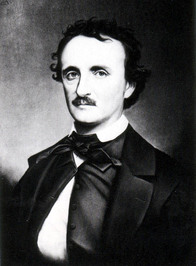
EDGAR ALLAN POE
 ANALYSIS OF THE TELL-TALE HEART
1.What is the meaning of the Tell-Tale Heart?
At the most obvious level, the title refers to the beating of the old man’s heart. The heart “tells tales” to the narrator. Tales, as you well know, are stories, and can be based on either real or imagined events. In either case, tellers of tales want to keep the reader or listener paying attention, and will often resort to extreme exaggerations to achieve that goal.
So, what tales does the old man’s heart tell? We first hear his heart beating on the eighth night, when he realizes that something is not right in his room. His heart tells a tale of fear, which in turn makes the narrator extremely angry and gives him the push he needs to carry out his dastardly deed.
The next time we hear the beating of the heart is after the old man is dead. See, this is part of why the narrator tells us he cut up the body before burying it under the floorboards. If it wasn’t for that step, we could imagine that the old man maybe wasn’t quite as dead as the narrator thought. Since that isn’t a possibility, and since we know that dead hearts don’t beat, the narrator’s own hidden guilt over the deed is projected onto the dead man’s heart, thus telling a tale of the narrator’s guilty feelings.
So, the title also refers to the narrator’s heart. Inside the heart is where our deepest, truest feelings and emotions live, at least metaphorically speaking. We could look at the whole story of the old man’s murder as a tale told by the narrator, a tale from his own heart. The title refers to both the narrator’s heart, and to the old man’s heart, and to the tales told by both.
2. What is the symbolism of the story?
THE OLD MAN’S EYE
The old man’s eye is blue with a “film” or “veil” covering it. This could be a medical condition, like a corneal ulcer, but symbolically it means that the characters have issues with their “inner vision” – what’s commonly known as one’s outlook on the world. They are stuck. Everything is obscured for them. Our reading of the story is likewise filtered through this hazy eye, causing at least some confusion and frustration with the text.
The eye also does some pretty weird stuff. It seems dull and unseeing – yet, it has strange powers. It makes the narrator’s blood run cold. It “chill[s] the very marrow in [his] bones” (6). After hiding the old man’s body, the narrator “replaced the boards so cleverly, so cunningly, that no human eye – not even his [the old man’s] – could have detected any thing wrong” (8). Interesting. That statement implies that at some point the eye could see hidden or secret things.
The eye also seems to have a bodyguard, the heart. When the narrator trains the beam on the open eye, it causes the heart to beat an alert. When the policemen are there, the heart beats loudly to alert the cops – so the eye can again see and be seen.
The narrator is fixated on the “vulture eye” aspect of the old man’s eye. He brings it up three times. Vultures prey on the sick or dead, and they gorge themselves to the point of stupor. Whether or not the old man is a vulture-like person, we can’t know. But that’s what he symbolizes to the narrator. If vultures prey on the dead and almost dead, and the narrator is afraid of the “vulture eye,” does this mean the narrator is dead or almost dead?
THE WATCH
The narrator mentions a “watch” four times in the story. A watch is a visual and auditory representation of time. The watch watches time, and tells tales of time. Time can also be said to be watching death, up ahead in the distance. Each tick of the watch symbolizes a movement closer to the inevitable death that all humans face. Poe presents this subtly in the story’s first mention of the watch: “A watch’s minute hand moves more quickly than did mine” (4).
This of course is on the eighth night. Here the narrator compares himself to a watch, a watch watching the old man’s death. The narrator steals time’s power as an agent of death. The narrator literally controls the time of the old man’s death. He’s a walking “death watch.”
This metaphor/word play becomes more explicit in the second mention of time in the story: “He was still sitting up in the bed listening; – just as I have done, night after night, hearkening to the death watches in the wall” (4).
This is a mystifying line, until we know that “death watches” are kind of beetle. Death watch beetles live inside walls, and bang their heads on said walls to attract mates (source). Poe might not have known this was a mating call, and was likely referring only to the popular belief that the banging is a countdown to someone’s death. Then again, maybe he did know. Intentionally or not, this odd moment in the novel juxtaposes sex and death in a way that would have made Sigmund Freud proud. In Beyond the Pleasure Principle Freud theorized that death and sex are intimately and intricately intertwined.
THE LANTERN
This lantern is pretty cool. You can burn a candle or oil in it (doesn’t say which in the story), but it has hinged panels that can be adjusted to let in as much or as little light as you want. The narrator keeps most of the light hidden, only allowing one “ray” to escape. This lantern is the narrator’s weapon against the old man’s eye. That’s what we see on the eighth night – the lantern and the eye in a stare-down. It also suggests that sometimes there is light hiding in the darkest places. If we can figure our how to get our lanterns open, we can see it. Can you find any hidden light in this dark tale?
THE BED AND THE BEDROOM
The bed in “The Tell-Tale Heart” symbolizes the opposite of what beds and bedrooms should be about. The narrator violates all bedroom etiquette, by exploiting the vulnerability of one who is sleeping. We are perhaps most vulnerable in bed, and we sleep well when we feel safe in our bedrooms. Poe turns the symbol of the bed on its head. The narrator uses the bed as weapon to snuff out the old man. And since the bed is the murder weapon, it’s logical that the bedroom is the burial place. Creepy.
3. What is the mood and tone of the story?
“Dreadfully Nervous,” Sad
While some Poe stories have a kind of fun and playful feel to them in spite of their themes of death, murder, and betrayal, “Tell-Tale” makes us want to cry. The narrator is so pathetic and, as we suggest in his “Character Analysis,” is probably physically ill. The narrator seems to have had a pretty bad life, which probably only gets worse after the murder and subsequent confession.
“Tell-Tale” is much different. The sadness is woven in the nervousness we find in every line. This story might not seem sad at all on the first read. We are somewhat amused by the narrator’s ridiculous arguments and think the whole thing might be a sick joke. Perhaps we feel slightly superior as we unravel all the discrepancies. But, upon reflection, we realize we’ve read the story of a man who, plagued by diseases of the body of the mind, is in a near constant state of stress, nerves, and meltdown.
Even if he is a murderer, the narrator is a sad figure, and it comes through in the nervous, frantic tone of the story.
4. What is the conflict, climax and resolution of the Tell-Tale Heart?
Conflict
Open your eye!
The narrator goes to the old man’s room every night for a week, ready to do the dirty deed. But, the sleeping man won’t open his eye. Since the eye, not the man, is the problem, the narrator can’t kill him if the offending eye isn’t open.
Complication
The narrator makes a noise while spying on the old man, and the man wakes up – and opens his eye.
This isn’t much of a complication. The man has to wake up in order for the narrator to kill him. If the man still wouldn’t wake up after months and months of the narrator trying to kill him, now that would be a conflict.
Climax
Murder…
The narrator kills the old man with his own bed and then cuts up the body and hides it under the bedroom floor.
Suspense
Uh-oh, the police.
The narrator is pretty calm and collected when the police first show up. He gives them the guided tour of the house, and then invites them to hang out with him in the man’s bedroom. But, the narrator starts to hear a terrible noise, which gets louder and louder, and…
Denouement
Make it stop, please!
Well, the noise gets even louder, and keeps on getting louder until the narrator can’t take it anymore. Thinking it might make the noise stop, the narrator tells the cops to look under the floorboards.
Conclusion
The narrator identifies the source of the sound.
Up to this moment, the narrator doesn’t identify the sound. It’s described first as “a ringing,” and then as “a low, dull, quick sound – much such a sound as a watch makes when enveloped in cotton” (9). Only in the very last line does the narrator conclude that the sound was “the beating of [the man’s] hideous heart!” (10)
5. What is the moral lesson in the story?
The moral of “The Tell–Tale Heart” is that we should not commit crimes because, in the end, our own sense of guilt will expose us. In this story, the narrator takes cares of an elderly man but grows to fear and loathe what he calls his “Evil Eye.” He becomes obsessed with it and decides to murder the old man.
6. Who is Edgar Allan Poe?
| Edgar Allan Poe | |
|---|---|

1849 “Annie” daguerreotype of Poe
|
|
| Born | Edgar Poe January 19, 1809 Boston, Massachusetts, U.S. |
| Died | October 7, 1849 (aged 40) Baltimore, Maryland, U.S. |
| Alma mater | University of Virginia United States Military Academy |
| Spouse |
Virginia Eliza Clemm Poe
(m. 1836; d. 1847) |
|
|
|
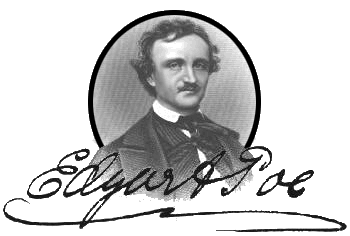
| Signature |  |
Edgar Allan Poe (/poʊ/; born Edgar Poe; January 19, 1809 – October 7, 1849) was an American writer, editor, and literary critic. Poe is best known for his poetry and short stories, particularly his tales of mystery and the macabre. He is widely regarded as a central figure of Romanticism in the United States and American literature as a whole, and he was one of the country’s earliest practitioners of the short story. Poe is generally considered the inventor of the detective fiction genre and is further credited with contributing to the emerging genre of science fiction.[1] He was the first well-known American writer to try to earn a living through writing alone, resulting in a financially difficult life and career.[2]
Poe was born in Boston, the second child of two actors. His father abandoned the family in 1810, and his mother died the following year. Thus orphaned, the child was taken in by John and Frances Allan of Richmond, Virginia. They never formally adopted him, but Poe was with them well into young adulthood. Tension developed later as John Allan and Poe repeatedly clashed over debts, including those incurred by gambling, and the cost of secondary education for Poe. He attended the University of Virginia but left after a year due to lack of money. Poe quarreled with Allan over the funds for his education and enlisted in the Army in 1827 under an assumed name. It was at this time that his publishing career began, albeit humbly, with the anonymous collection Tamerlane and Other Poems (1827), credited only to “a Bostonian”. With the death of Frances Allan in 1829, Poe and Allan reached a temporary rapprochement. However, Poe later failed as an officer cadet at West Point, declaring a firm wish to be a poet and writer, and he ultimately parted ways with John Allan.
Poe switched his focus to prose and spent the next several years working for literary journals and periodicals, becoming known for his own style of literary criticism. His work forced him to move among several cities, including Baltimore, Philadelphia, and New York City. In Richmond in 1836, he married Virginia Clemm, his 13-year-old cousin. In January 1845, Poe published his poem “The Raven” to instant success. His wife died of tuberculosis two years after its publication. For years, he had been planning to produce his own journal The Penn (later renamed The Stylus), though he died before it could be produced. Poe died in Baltimore on October 7, 1849, at age 40; the cause of his death is unknown and has been variously attributed to alcohol, “brain congestion”, cholera, drugs, heart disease, rabies, suicide, tuberculosis, and other agents.[3]
Poe and his works influenced literature in the United States and around the world, as well as in specialized fields such as cosmology and cryptography. Poe and his work appear throughout popular culture in literature, music, films, and television. A number of his homes are dedicated museums today. The Mystery Writers of America present an annual award known as the Edgar Award for distinguished work in the mystery genre.
 LITERATURE